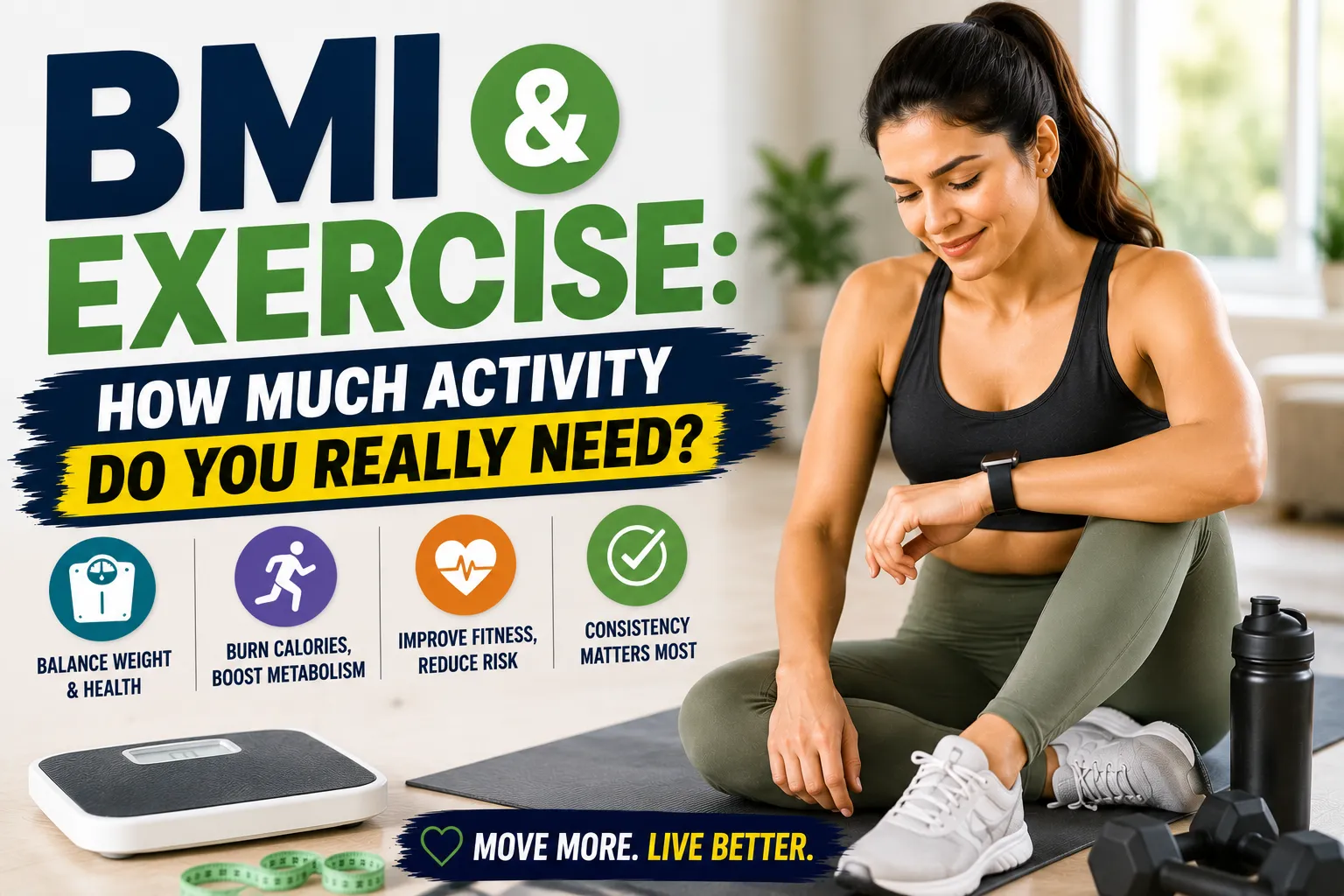
BMI and Exercise: How Much Activity Do You Really Need?
BMI Calculator
Calculate Your BMIYou know exercise is good for you. But how much do you actually need? And does your BMI change the answer?
The short answer is yes. Different BMI categories have different exercise needs and different risks. But the good news is that any amount of exercise helps, regardless of your starting point.
Here's what you need to know about BMI and exercise.
Calculate Your BMI
Free BMI CalculatorGeneral Exercise Guidelines
The World Health Organization (WHO) recommends:
- Adults (18-64): At least 150 minutes of moderate-intensity aerobic activity per week (30 minutes, 5 days a week) or 75 minutes of vigorous activity per week
- Plus: Strength training exercises at least 2 days per week
- Older adults (65+): The same, plus balance exercises 3 days per week
These are the minimums. Research shows that more is often better, especially for people with higher BMIs.
Exercise Recommendations by BMI Category
Normal BMI (18.5-24.9):
You're at a healthy weight. Exercise is about maintaining your health and preventing future weight gain.
- Goal: 150-300 minutes of moderate activity weekly
- Strength training: 2-3 days weekly
- Focus: Variety and consistency
Overweight (25-29.9):
You may benefit from more exercise than the minimum recommendations. Research shows that people with overweight need more activity to achieve the same health benefits as people with normal BMI.
- Goal: 200-300 minutes of moderate activity weekly
- Strength training: 2-3 days weekly
- Focus: Weight loss and cardiovascular health
Obese Class I (30-34.9):
Exercise is especially important for reducing health risks. More activity is needed to achieve weight loss and improve metabolic health.
- Goal: 250-300+ minutes of moderate activity weekly
- Strength training: 3 days weekly
- Focus: Weight loss and reducing inflammation
Obese Class II and III (35+):
Starting slowly is important. High-impact exercise may be hard on your joints. Focus on low-impact activities that you can maintain.
- Goal: 200-300 minutes of moderate activity weekly
- Strength training: 2-3 days weekly
- Focus: Joint-friendly activities and gradual progression
Infographic: Exercise Recommendations by BMI
| BMI Category | Moderate Activity | Strength Training | Focus |
|---|---|---|---|
| Normal (18.5-24.9) | 150-300 min/week | 2-3 days | Maintenance |
| Overweight (25-29.9) | 200-300 min/week | 2-3 days | Weight loss |
| Obese I (30-34.9) | 250-300+ min/week | 3 days | Weight loss + inflammation |
| Obese II/III (35+) | 200-300 min/week | 2-3 days | Joint-friendly + gradual |
Why People with Higher BMI Need More Exercise
Research shows that people with higher BMIs need more exercise to achieve the same health benefits as people with lower BMIs. A study published in the journal Obesity found that people with obesity need about 60-90 minutes of daily exercise to maintain weight loss, compared to 30 minutes for people with normal BMI.
This isn't a punishment—it's just the physics of energy balance. Your body adapts to weight loss by slowing down metabolism. More activity helps overcome this adaptation.
Best Exercises for Different BMI Categories
Normal BMI:
- Running or jogging: Good for cardiovascular health
- Strength training: Maintains muscle mass
- Group classes: Zumba, HIIT, spin classes
- Sports: Tennis, basketball, swimming
Overweight:
- Walking: Start with 30 minutes daily
- Swimming: Low-impact, full-body workout
- Cycling: Stationary or outdoor, gentle on joints
- Strength training: Focus on major muscle groups
Obese Class I:
- Walking: Gradually increase to 45-60 minutes
- Water aerobics: Low-impact, supportive
- Elliptical machine: Low-impact cardio
- Resistance bands: Gentle strength training
Obese Class II and III:
- Chair exercises: Seated movements
- Walking: Start with 5-10 minutes, gradually increase
- Swimming: Excellent for joint health
- Water aerobics: Supportive and low-impact
- Physical therapy: Guided by a professional
How to Start Exercising Safely
1. Start Slowly
Don't try to do everything at once. Start with 5-10 minutes of walking daily. Gradually increase the duration and intensity.
2. Listen to Your Body
Pay attention to pain. Mild discomfort is normal, but sharp pain is a warning sign. Stop if you feel pain in your joints or chest.
3. Find Activities You Enjoy
You're more likely to stick with exercise if you enjoy it. Try different activities until you find what works for you.
4. Make It Social
Walk with a friend, join a class, or exercise with a group. Social support increases adherence.
5. Be Consistent, Not Perfect
It's better to exercise for 10 minutes daily than for 2 hours once a week. Consistency matters more than intensity.
When to See a Doctor
Before starting a new exercise program, talk to your doctor if:
- Your BMI is 30 or higher
- You have other health conditions (heart disease, diabetes, high blood pressure)
- You have joint pain or mobility issues
- You're over 65
- You've been inactive for a long time
Know Your Numbers
Calculate your BMI and get personalized exercise recommendations.
Free Health AssessmentFrequently Asked Questions
Can I exercise if my BMI is very high?
Yes. But start slowly and focus on low-impact activities. Walking, swimming, and water aerobics are excellent choices. Always consult your doctor before starting.
How much exercise do I need to lose weight?
To lose weight through exercise alone, you may need 60-90 minutes of moderate activity daily. However, diet is more important for weight loss. Combine exercise with dietary changes for best results.
What if I can't do high-impact exercise?
Low-impact activities like walking, swimming, cycling, and water aerobics are effective and gentle on joints. Many people achieve great results with these activities alone.
Can I split my exercise into shorter sessions?
Yes. Research shows that three 10-minute sessions are as effective as one 30-minute session. This is especially helpful if you have a busy schedule.
Scientific References
- World Health Organization. Physical activity guidelines.
- American College of Sports Medicine. Exercise and BMI.
- Obesity journal. Exercise requirements for weight loss.
Key Takeaways
- WHO recommends 150 minutes of moderate activity weekly for adults
- People with higher BMI often need more exercise for weight loss
- Normal BMI: 150-300 minutes, Overweight: 200-300 minutes, Obese: 250-300+ minutes
- Strength training 2-3 days weekly is essential for all BMI categories
- Higher BMI individuals benefit from low-impact exercises like walking and swimming
- Start slowly and gradually increase duration and intensity
- Consistency matters more than intensity
- Find activities you enjoy for long-term adherence
- Listen to your body and stop if you feel pain
- Consult your doctor before starting a new exercise program
Check Your BMI
BMI Calculator
You May Also Like