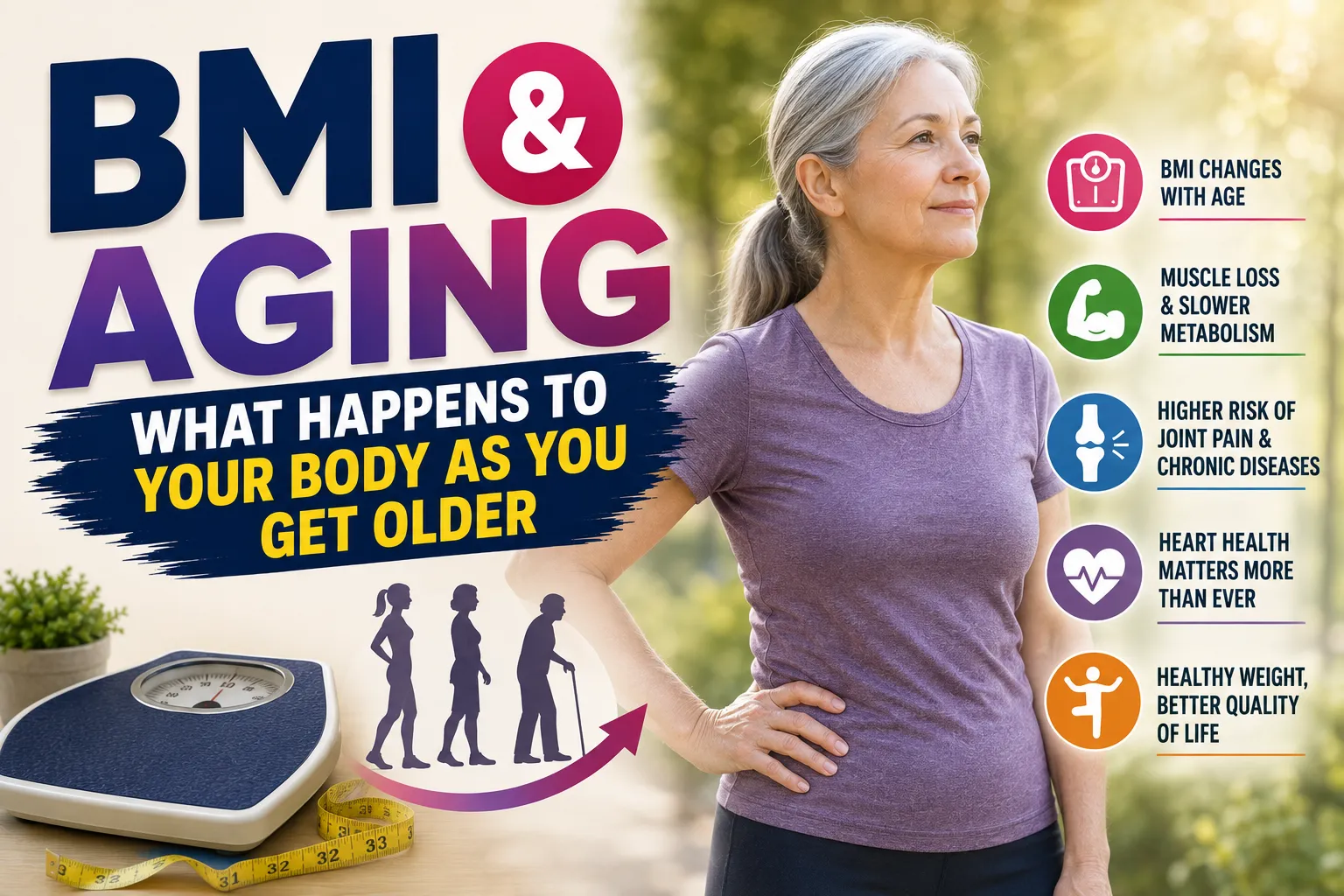
BMI and Aging: What Happens to Your Body as You Get Older
BMI Calculator
Calculate Your BMIYou step on the scale. The number is higher than it was ten years ago. You're eating the same. Exercising the same. But your body is different.
This isn't a mystery. It's aging.
As you get older, your body composition changes. You lose muscle. You gain fat. Your metabolism slows down. And your BMI—which only measures weight relative to height—can't tell you any of this.
Here's what actually happens to your body as you age and why it matters.
Calculate Your BMI
Free BMI CalculatorWhat Changes with Age
Your body changes significantly with age. Here's what happens:
1. You Lose Muscle
After age 30, adults lose about 3-5% of muscle mass per decade. By age 65, most people have lost 10-15% of their muscle. This is called sarcopenia.
Less muscle means lower metabolism. Lower metabolism means fewer calories burned. And fewer calories burned means easier weight gain.
Why this matters: A woman who weighs 65 kg at 40 might have 28% body fat. At 60, she might weigh the same but have 35% body fat. Her BMI hasn't changed. Her health has.
2. Your Metabolism Slows
Your resting metabolic rate decreases by about 10-15% between age 30 and 60. This means you burn 150-250 fewer calories per day. That's enough to gain 5-10 kg over a decade.
3. Your Hormones Change
For women, menopause causes estrogen to drop. This leads to fat redistribution from hips and thighs to the abdomen. For men, testosterone declines gradually, reducing muscle mass and increasing fat storage.
4. Your Height Changes
Your height decreases with age due to spine compression, posture changes, and disc dehydration. This affects your BMI calculation—and not in a good way. Less height means higher BMI for the same weight.
5. Your Body Composition Shifts
Fat shifts from subcutaneous (under the skin) to visceral (around organs). Visceral fat is more dangerous and causes more health problems.
BMI vs Age
| Age Group | Healthy BMI Range | Why Different |
|---|---|---|
| 20-30 years | 18.5 - 24.9 | Standard WHO range |
| 30-40 years | 18.5 - 24.9 | Same range, but muscle loss begins |
| 40-50 years | 18.5 - 24.9 | Perimenopause begins for some women |
| 50-60 years | 19 - 26 | Slightly higher range may be better |
| 60-70 years | 23 - 27 | Higher range linked to lower mortality |
| 70-80 years | 24 - 28 | Energy reserves become important |
| 80+ years | 24 - 29 | Focus on muscle preservation and function |
Infographic: Aging and Body Composition
| Age | Muscle Mass | Body Fat | Metabolism |
|---|---|---|---|
| 20-30 | High | Low | Fast |
| 30-40 | Moderate | Moderate | Moderate |
| 40-50 | Declining | Increasing | Slowing |
| 50-60 | Low | High | Slow |
| 60+ | Very Low | Very High | Very Slow |
Why BMI Becomes Less Accurate with Age
As you age, BMI becomes a less reliable indicator of health for several reasons:
1. Muscle Loss
Your BMI might say "normal," but you could have low muscle and high fat. This is called sarcopenic obesity. It increases health risks even with normal BMI.
2. Height Loss
Your height decreases with age. A 65-year-old woman who was 165 cm at 40 might be 163 cm at 65. The same weight gives a higher BMI. It's not weight gain—it's height loss.
3. Fat Redistribution
Fat moves from subcutaneous to visceral as you age. Visceral fat is more dangerous and causes more health problems. BMI doesn't measure fat distribution.
What Matters More Than BMI After 60
1. Waist Circumference
Waist size measures visceral fat. It's more important than BMI for older adults.
Healthy waist for women over 60: Less than 88 cm (34.6 inches)
Healthy waist for men over 60: Less than 94 cm (37 inches)
2. Muscle Mass
Your ability to build and maintain muscle is a better predictor of health than BMI after 60. Lower muscle mass is linked to higher mortality.
3. Functional Ability
How you function matters more than how much you weigh. Can you walk up stairs? Can you carry groceries? Can you get up from a chair without using your hands? These are the real health indicators.
What You Can Do
1. Prioritize Protein
As you age, you need more protein, not less. Aim for 1.2-1.5g per kg of body weight. For a 65 kg woman, that's 78-98 grams of protein daily.
Good sources: Eggs, Greek yogurt, cottage cheese, chicken, fish, tofu, lentils.
2. Strength Training 2-3 Times Weekly
Strength training is the most important thing you can do for your health after 50. It preserves muscle, improves bone density, and reduces fall risk.
Exercises: Squats, lunges, wall push-ups, seated leg lifts, resistance bands.
3. Walk 30 Minutes Daily
Walking improves cardiovascular health, maintains mobility, and helps with weight management. It doesn't put stress on your joints and can be done almost anywhere.
4. Eat Regular Meals
As you age, you might lose your appetite. This can lead to unintentional weight loss, which is dangerous. Eating regular meals—even when you're not hungry—helps maintain weight and nutritional status.
5. Stay Hydrated
Older adults often don't feel thirsty even when dehydrated. Drink water throughout the day, even if you don't feel thirsty.
When to See a Doctor
Consult your healthcare provider if:
- Your BMI is below 23 or above 30
- Your waist circumference exceeds healthy limits
- You've lost weight unintentionally (5% or more in 6 months)
- You feel weak, tired, or have difficulty with daily activities
- You have other health conditions (diabetes, heart disease, high blood pressure)
Frequently Asked Questions
Does BMI increase with age?
BMI often increases with age due to muscle loss, fat gain, and height loss. But it's not inevitable. Regular exercise and good nutrition can slow these changes.
What is a healthy BMI for a 70-year-old woman?
For women over 70, the optimal BMI range is 24 to 28. But functional ability, muscle strength, and overall health matter more than the number.
Can I lose weight after 60?
Yes. But focus on preserving muscle while you lose weight. Strength training and adequate protein are essential. Aim for gradual weight loss (0.5-1 kg per week).
Why am I gaining weight despite eating the same?
Your metabolism has slowed down. You're burning fewer calories than you used to. This is a natural part of aging. Adjusting your diet and increasing physical activity can help.
Scientific References
- National Institute on Aging. Healthy aging and weight management.
- Journal of Nutrition, Health & Aging. BMI and mortality in older adults.
- American Journal of Clinical Nutrition. Age-related changes in body composition.
Key Takeaways
- After age 30, adults lose 3-5% of muscle mass per decade
- Metabolism slows 10-15% between age 30 and 60
- Hormonal changes cause fat redistribution to the abdomen
- Height loss affects BMI calculation
- For seniors, optimal BMI range is 23-27
- Waist circumference is more important than BMI after 60
- Strength training preserves muscle and reduces fall risk
- Protein needs increase with age (1.2-1.5g per kg)
- Functional ability matters more than weight
- Unintentional weight loss after 60 should be checked by a doctor
Check Your BMI
BMI Calculator
You May Also Like