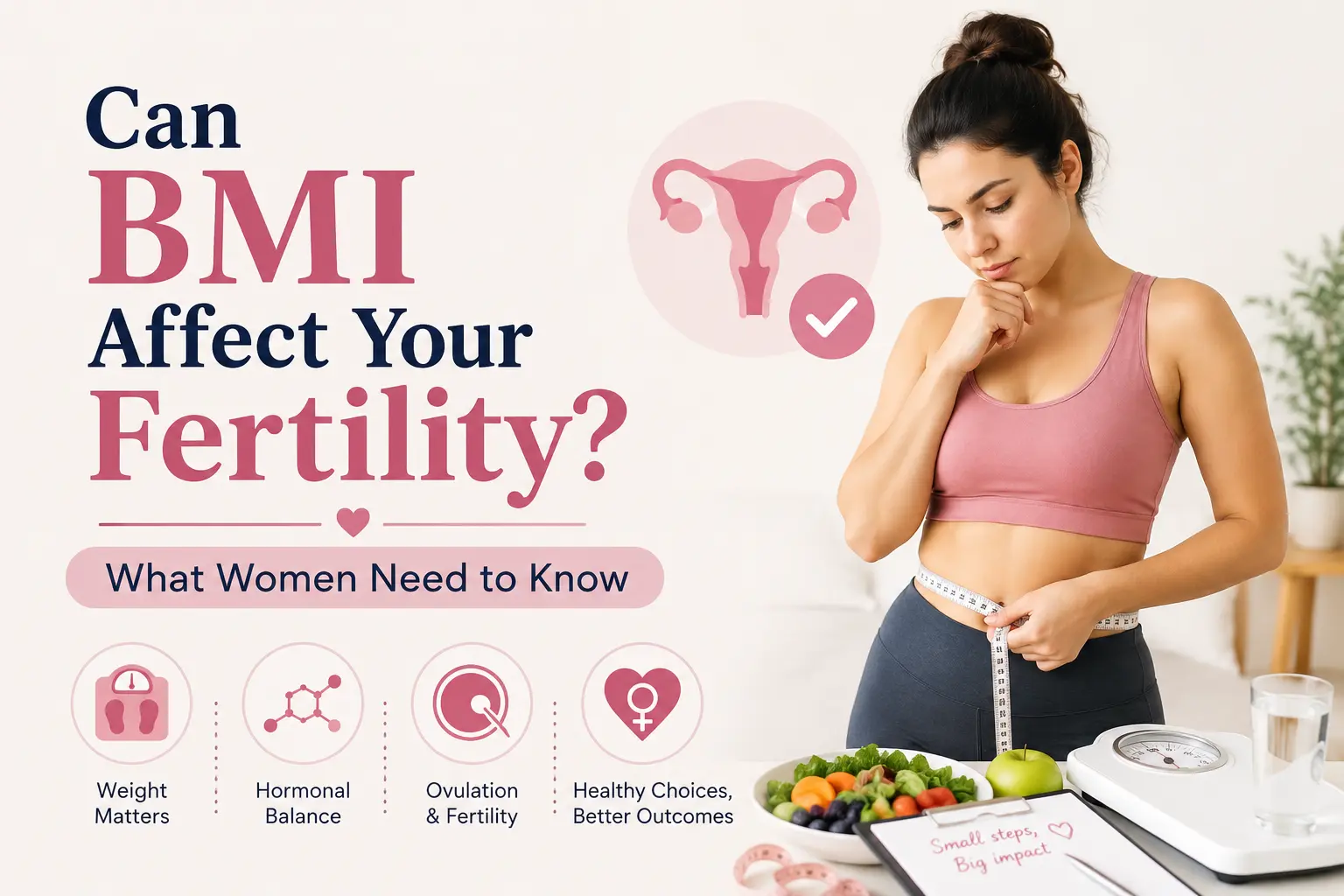
Can BMI Affect Your Fertility? What Women Need to Know
BMI Calculator
Calculate Your BMIIf you're trying to conceive or planning to start a family, you've probably thought about a lot of things: timing, nutrition, stress, and maybe even your age. But have you thought about your BMI?
Your Body Mass Index isn't just a number that tells you if you're at a healthy weight. It can also affect your fertility. And the connection is more significant than many women realize.
The good news? Unlike some fertility factors you can't change, your weight is something you can work on. Small changes can make a real difference.
Calculate Your BMI
Free BMI CalculatorWhat the Research Says
Multiple studies have shown that both high and low BMI can affect fertility in women. The relationship isn't linear—it's more like a U-shape. Both extremes of the BMI spectrum are associated with fertility challenges.
A large study published in the journal Human Reproduction found that women with a BMI above 30 had significantly lower pregnancy rates than women in the normal BMI range. The study also found that women with a BMI below 18.5 had similar challenges.
Research from the American Society for Reproductive Medicine shows that even modest weight loss can improve fertility outcomes. Women who lost 5-10% of their body weight often saw improvements in ovulation and menstrual regularity.
Another study found that women with a high BMI had longer times to conception. On average, women with obesity took 30-50% longer to conceive than women in the normal BMI range.
How BMI Affects Fertility
Your BMI can affect your fertility in several ways:
1. Hormonal Balance
Fat tissue produces hormones. When you have too much fat tissue, your body produces more of certain hormones and less of others. This disrupts the delicate hormonal balance needed for ovulation and regular menstrual cycles.
In particular, excess fat tissue produces estrogen. High estrogen levels can disrupt ovulation and make it harder to conceive. This is why women with high BMI often have irregular periods or even miss periods entirely.
2. PCOS Connection
Polycystic Ovary Syndrome is a common cause of infertility affecting 5-10% of women of reproductive age. PCOS is strongly linked to higher BMI and insulin resistance. Research shows that 40-80% of women with PCOS are overweight or obese.
Women with PCOS often have difficulty ovulating. But even modest weight loss of 5-10% can improve menstrual regularity, ovulation, and pregnancy rates. This is why lifestyle changes are often the first-line treatment for PCOS.
3. Low BMI and Anovulation
On the other end of the spectrum, low BMI can cause anovulation—no egg release. Your body needs adequate fat tissue to produce hormones. Without enough fat tissue, your body stops producing estrogen. Menstrual cycles become irregular or stop entirely.
Women with low BMI often have amenorrhea—the absence of periods. This is your body's way of protecting itself when energy resources are low. Your body prioritizes survival over reproduction.
4. Insulin Resistance
High BMI is often associated with insulin resistance. When your cells become less sensitive to insulin, your body produces more insulin to compensate. High insulin levels disrupt ovulation and can cause PCOS.
This is why women with high BMI often need help with both weight management and insulin regulation when trying to conceive.
BMI and Fertility Treatment Success
Your BMI doesn't just affect your ability to conceive naturally—it can also affect fertility treatment success.
Research shows that women with high BMI have lower success rates with in vitro fertilization (IVF) and other fertility treatments. Studies have found that live birth rates are significantly lower for women with BMI above 30 compared to women with normal BMI.
This isn't about judgment. It's about how your body responds to treatment. Higher BMI can affect hormone levels, egg quality, embryo implantation, and even how the body responds to fertility medications.
In fact, many clinics have BMI limits for fertility treatment due to safety concerns. General anesthesia carries higher risks for women with high BMI. Egg retrieval procedures also have higher complication rates.
What About Women with Low BMI?
Low BMI can also affect fertility treatment success. Women with BMI below 18.5 often have lower pregnancy rates with both natural conception and fertility treatments. There are fewer studies on low BMI, but the ones available show similar patterns.
Your body needs adequate nutrition to support a pregnancy. When you're underweight, your body may not have the reserves needed to sustain a pregnancy. This is why achieving a healthy weight before conception is often recommended.
What You Can Actually Do
The good news is that you have some control over this factor. Here are practical steps you can take:
If your BMI is high: Losing just 5-10% of your body weight can improve fertility. This can mean the difference between irregular periods and regular ovulation.
If your BMI is low: Gaining a few kilograms can restore hormonal balance and menstruation. Focus on nutrient-dense foods and strength training.
Talk to your doctor: Before making significant changes, talk to your healthcare provider. They can help you set realistic goals and monitor your progress.
Walk 30 minutes daily: Moderate exercise improves insulin sensitivity and helps with weight management. It's simple, free, and effective.
Eat more protein: Protein supports hormone production and helps with weight management. Aim for 25-30 grams per meal.
Don't stress about perfection: Small changes add up. Every kilogram lost or gained toward a healthy range helps.
Beyond the Number
BMI is a starting point, not the whole picture. Waist circumference matters too—visceral fat is more harmful than fat elsewhere. Your overall health matters more than any single number.
Some women with high BMI conceive easily. Some women with normal BMI struggle. BMI is one factor among many. But it's a factor you can work on.
When to See a Doctor
If you've been trying to conceive for more than a year (or six months if you're over 35), talk to your doctor about your fertility. They can check for other factors, such as PCOS, thyroid issues, or blocked fallopian tubes.
Your doctor can also help you create a weight management plan that supports your fertility goals. This is a partnership, not a solo journey.
Start Tracking Your Health
Calculate your BMI and get personalized health insights.
Free Health AssessmentFrequently Asked Questions
What BMI is best for fertility?
A BMI between 18.5 and 24.9 is considered optimal for fertility. Both high and low BMI can affect ovulation and conception.
Does losing weight help fertility?
Yes. Losing 5-10% of body weight can improve ovulation, menstrual regularity, and fertility treatment success.
Can low BMI cause infertility?
Yes. Low BMI can cause anovulation and amenorrhea, making it difficult to conceive.
Does PCOS affect BMI?
PCOS is strongly linked to higher BMI. Weight loss is often recommended as a treatment for PCOS and can improve ovulation and pregnancy rates.
Scientific References
- American Society for Reproductive Medicine. Weight and fertility.
- Human Reproduction. BMI and pregnancy rates.
- Teede, H. J., et al. (2018). PCOS and weight management. Fertility and Sterility.
Key Takeaways
- Both high and low BMI can affect fertility in women
- Women with BMI above 30 have significantly lower pregnancy rates
- Even modest weight loss (5-10%) can improve fertility
- Low BMI can cause anovulation and amenorrhea
- PCOS is strongly linked to higher BMI
- Weight loss improves ovulation, menstrual regularity, and fertility treatment success
- Insulin resistance from high BMI disrupts ovulation
- Talk to your doctor about your fertility and weight management goals
- Small changes make a difference
- BMI is one factor among many, but it's one you can work on
Check Your BMI
BMI Calculator
You May Also Like